Barcelona’s Retro Gaming Scene: The Convention, the Shops and the Community
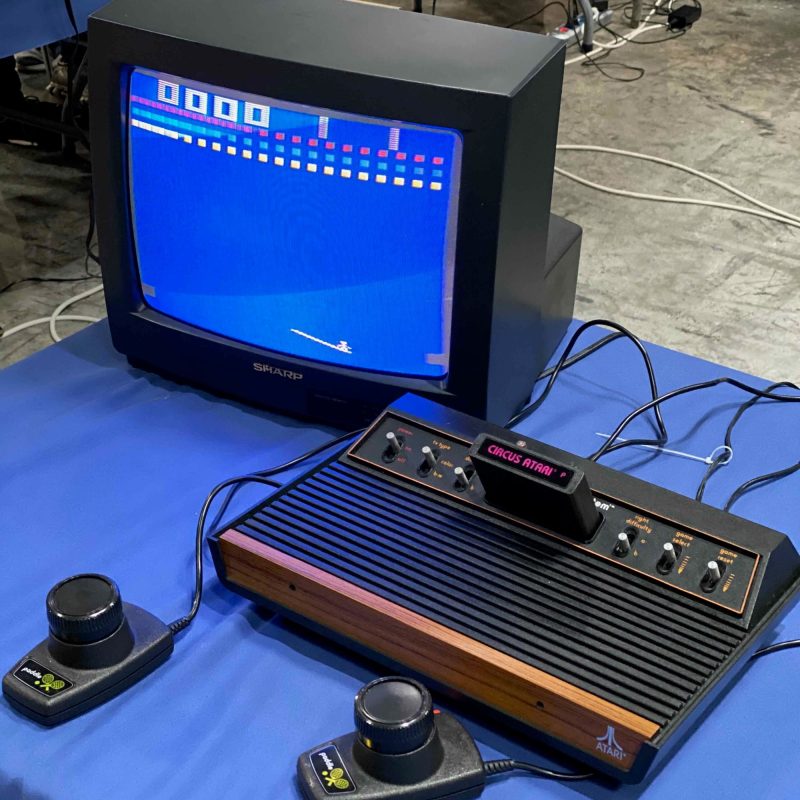
An Atari 2600 running Circus Atari on a Sharp CRT with two paddle controllers, set up to play at the Retro Barcelona convention.

The irresistible pull of the past

In an age of hyper-realistic graphics, the enduring appeal of retro gaming is a curious anomaly. Why do we stay captivated by the pixelated past? It is a mix of nostalgia, elegant design simplicity, and real appreciation for the craft that paved the way for today’s blockbusters. That feeling is very much alive in Barcelona, a city better known for its architecture and its food, but quietly home to a busy retro gaming community.

This is not just about digging out dusty cartridges. It is a cultural habit: a collective fondness for a time when gameplay came first and imagination filled in the graphical gaps. Barcelona has become an unexpected hub for that kind of digital archaeology, from a large annual convention to a handful of small, well-stocked shops.

Here is where to find it.

Retro Barcelona: the big annual gathering

Picture chiptune music competing with the clatter of arcade joysticks, and several generations playing the same games side by side. That is Retro Barcelona, a non-profit cultural association set up to preserve classic technology and video games. It has been running for over a decade and its flagship event, also called Retro Barcelona, is the biggest date in the Spanish retro gaming calendar.

The 11th edition ran on 16 and 17 May 2026 at La Farga de l’Hospitalet, open 10:00 to 20:00 on both days, across roughly 7,000 m² after an expansion from the previous 6,000 m². That edition brought over two composers whose work needs no introduction to anyone who grew up with a controller in hand: Yoko Shimomura (Street Fighter II, Kingdom Hearts) and Michiru Yamane (Castlevania).
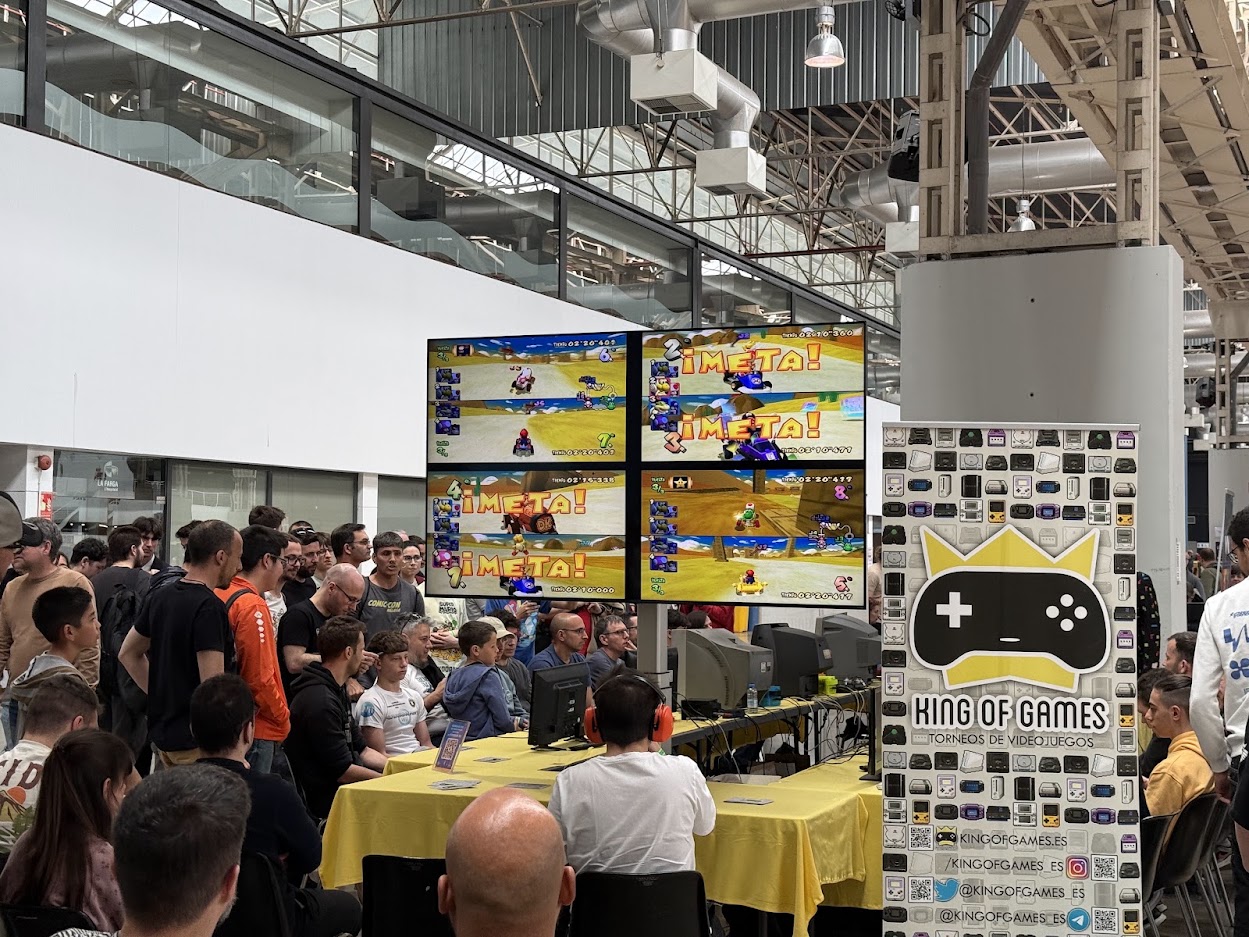
A crowd watching a four-screen Mario Kart tournament run by King of Games at Retro Barcelona.
Tournament play on the big screens, run by King of Games. Photo: RetroShell.

The format stays broadly the same each year. There is a gaming zone with hundreds of playable classic systems, a video game museum covering the history properly, and a sales floor of exhibitors selling retro games, consoles and merchandise. Alongside that sit conferences, official tournaments, talks, podcasts and workshops. It is the one weekend of the year when the whole Catalan retro scene is in the same building.
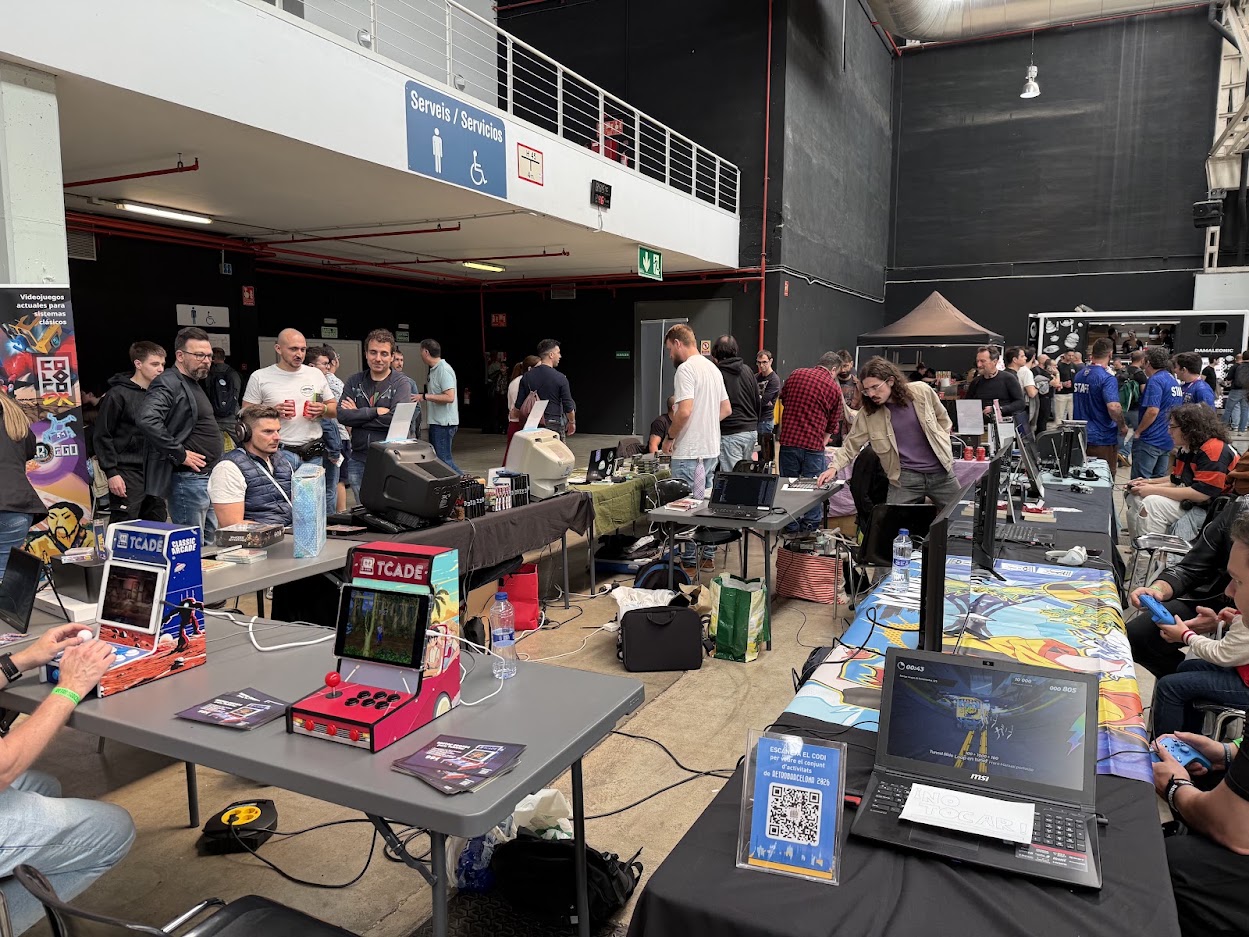
Visitors playing mini arcade cabinets and CRT setups on the exhibitor floor at Retro Barcelona in La Farga de l'Hospitalet.
Playable stands fill the floor at Retro Barcelona. Photo: RetroShell.

The event is normally held in May. Dates for the next edition are published on the association’s own site, and our friends at Barna.News covered the 2026 edition in English if you want the full rundown.

Where to shop the rest of the year

Retro Barcelona is once a year. The city’s retro pulse runs year-round in its shops, and these are less retail units than time capsules, each with its own character and its own carefully built stock.

World Viceous, Gràcia

World Viceous sits in the heart of Vila de Gràcia at Carrer del Progrés 42. It is a genuine treasure trove: consoles from 8-bit through 32-bit, a wide spread of games, vintage magazines and the accessories that are always the hard part. They also buy old games, which keeps the stock moving and keeps cherished machines in circulation rather than in landfill. There is an online store if you cannot get there, but the shop itself is the point: the owners know their history and are happy to talk about it.

Airun Retro Games, Encants Nous

Airun Retro Games is at Carrer Dos de Maig 227, in the Encants Nous market. It deals exclusively in retro, which makes for a tighter, more considered selection than a general games shop. It is the sort of place where the cartridge you have been hunting for years finally turns up in a box you nearly did not look in.

RetroPlayZone, Sant Martí

RetroPlayZone is at Carrer de Pere IV 151, in Sant Martí. It is the most comprehensive of the three, covering Mega Drive, Master System, Dreamcast, Game Boy, SNES, N64, Wii, PS2 and PS3 among others, with second-hand consoles sold under warranty. They buy, sell and trade, which makes them as much a marketplace for the community as a shop. Worth phoning ahead if you are after something specific.

Why retro still wins

What keeps pulling us back to these machines? At bottom, retro gaming answers a want for simplicity. Modern games, with their sprawling narratives and endless customisation, can be exhausting. Older games tend to offer a clear objective, controls you understand in thirty seconds, and an unbroken focus on play. The technical limits of the hardware forced developers to invent within tight constraints, and that is precisely what produced design ideas that still hold up.

There is also the art. Pixel art started as a technical necessity and is now a style people choose on purpose. The bold, stylised look of the 8-bit and 16-bit eras has a warmth that the chase for photorealism rarely manages. Those are not just dots on a screen; they are deliberate decisions that produced characters most of us could still draw from memory.

And then there is the company. For a lot of people these games are tied to specific evenings: friends round after school, an argument with a sibling over who got player one, the boss that took a fortnight. Playing them again, or finding them for the first time, builds a bridge between generations and starts conversations that a new release rarely does.

Barcelona, a retro gamer’s city

Barcelona is not only a good-looking European city with a strong food scene. It has a real, active retro gaming community, from the annual noise of Retro Barcelona to the quiet aisles of World Viceous, Airun Retro Games and RetroPlayZone. The past here is not just remembered. It is played, traded and looked after.

So whether you are a collector chasing a rare cartridge, a visitor after something other than another cathedral, or someone who simply wants to hear a Mega Drive boot again, the city is worth your afternoon.

You can also join the Barcelona English Speakers Gaming WhatsApp group to chat and play with like-minded people. And for everything else happening in the city, in English, have a look at Barna.News.

Game Boy Tetris Ported to Sega Genesis

From the RetroShell news archive. Originally published 2026-06-04 on our former news site and restored here.

For readers in London and across the UK retro scene, there is a fresh homebrew project putting Game Boy Tetris on the Sega Genesis. Developer AAR is working on Tetris DMG-01, an unofficial port that aims to stay close to the 1989 handheld original.

The project is a neat bit of retro history in motion. The original Game Boy version of Tetris helped turn Nintendo’s handheld into a huge hit in the West, and AAR’s goal is to recreate that feel on Sega hardware, with a colourised mode also planned for players who want a different look.

Sega’s own Tetris story is a messy one. The company did release a version for the Mega Drive, the European name for the Genesis, but it was pulled from sale after legal disputes over home console rights. That history has been covered in The Tetris Effect and in Apple’s recent film about the game.

The official Mega Drive Tetris, developed by Sanritsu Denki, was intended mainly for the Japanese market. It is now extremely scarce, with fewer than ten copies believed to exist. For collectors, that makes it one of the rarest official Sega releases, while the homebrew project offers a way to play a similar idea without chasing a near-mythical cartridge.

That is where the appeal of homebrew really shows. This is not about replacing the original, it is about filling a gap left by old licensing fights and giving Genesis fans something they were never properly able to buy. If you follow retro news on RetroShell, you can keep an eye on more developments through our News tag.

For the source trail, the project was first reported by Time Extension. For official background on Nintendo’s side of the story, see Nintendo’s news page.

Jet Set Radio Trailer Leak Splits Fans

From the RetroShell news archive. Originally published 2026-06-03 on our former news site and restored here.

In the latest retro gaming talking point, a low-resolution, watermarked trailer for a new Jet Set Radio game has leaked online, and the reaction has been sharply divided. For fans in the UK and beyond, it is a reminder that Sega’s long-promised revival of classic IPs is now edging closer, even if this first look is far from polished.

The leak was first reported by RetroDodo. The trailer itself is hard to read, with heavy watermarks and very low image quality, but it appears to show gameplay and characters. That has been enough to set off debate about whether the new game is staying true to the series’ visual identity.

Fans have waited 26 years since the original Jet Set Radio launched on the Dreamcast, and 24 years since Jet Set Radio Future arrived on Xbox. Some players are simply pleased to see any sign of a return. Others are unhappy with what they see as a shift away from the cel-shaded style that made the series stand out in the first place.

One X user, quoted by RetroDodo, wrote: “I love it when they strip the game of its visual identity and replace it with UE5 garbage, top-notch stuff, huh.” Other comments described the look as “slop”. The split reaction shows how closely this series is tied to its art direction, especially for long-time fans who value the original games’ identity.

Sega has already said that Jet Set Radio is part of a wider revival effort, alongside Golden Axe and Crazy Taxi, after the cancellation of its “Super Game” initiative. That makes this leak more than a curiosity, because it gives an early glimpse of how Sega may be handling one of its best-known names. For now, the company has not provided a full official reveal to settle the debate.

For more RetroShell coverage of Sega and other classic game news, keep an eye on our News tag. You can also follow the official Xbox Wire site for platform announcements, and RetroDodo for the original report.

ArcStation PS1 ODE, MiSTer Updates

From the RetroShell news archive. Originally published 2026-06-03 on our former news site and restored here.

RetroRGB’s latest weekly roundup is worth a look for retro fans in the UK and beyond, with the ArcStation PS1 ODE leading the news. The roundup also covers new MiSTer FPGA cores, a RetroTINK 5X Pro firmware update, and a few other hardware and software projects. Read the full roundup on RetroRGB, and see the RetroShell news tag for more retro gaming updates.

The ArcStation is a new plug-and-play optical disc emulator for the original PlayStation. In practical terms, it is designed to let owners load games from storage rather than rely on the console’s ageing CD-ROM drive, which can help keep original hardware in use for longer. The roundup describes it as a straightforward option, which should make it appealing to players who want a simpler route into PS1 hardware modding.

That ease of installation matters, because it lowers the barrier for people who want to preserve and play on original consoles. More involved options such as PSIO or XStation already have strong followings, but a plug-and-play approach gives the scene another route for keeping PlayStation 1 systems running without worn-out lasers and failing drives.

MiSTer FPGA also gets a solid update in the roundup, with a new PC core and additions for arcade titles including Atari Star Wars and Darius 2. MiSTer remains one of the most active FPGA platforms in retro gaming, and these regular core releases continue to widen what the system can do, from consoles to arcade hardware and now early personal computing.

Another item in the roundup is a firmware update for the RetroTINK 5X Pro, version 3.98. RetroTINK devices are widely used to connect older consoles to modern displays, so firmware support is a big part of keeping them useful. The roundup does not go into every change, but it is another sign that the device is still being actively maintained for retro setups.

The rest of the post includes an OmniDrive-compatible slimline disc ripper, an update to Super ZSNES with MSU-1 audio support and new scaling modes, and a Recalbox Raspberry Pi 5 JVS Arcade Kit. The original article is on RetroRGB. RetroShell also makes museum-grade acrylic game protectors for major console generations.

New Lost C64 Titles Added by Games That Werent

From the RetroShell news archive. Originally published 2026-06-03 on our former news site and restored here.

For retro fans in Britain, the latest update from Games That Werent is another useful step for Commodore 64 preservation. The database now includes four new unreleased C64 games and prototypes, alongside 22 updated entries.

The new additions are Dungeons and Magic, The Sanctuary, Thunder Light, and Trap Mission 4 Soccer Sims V1. The updated entries include 7 Minutes To Midnight, Rebelstar 2, and a deeper look at Orbyte Software titles, with fresh screenshots, code snippets, or developer recollections where available.

Games That Werent says this work is part of an ongoing effort to document software that never reached shop shelves. The site’s latest update also points to new recoveries coming very soon, which suggests there is still more unreleased 8-bit material to catalogue.

The Commodore 64 had a strong place in British home computing, alongside machines such as the ZX Spectrum and Amstrad CPC. That made it a busy platform for bedroom coders, publishers, and magazine coverage, but it also left behind a long trail of unfinished projects and lost code.

For readers following retro news, the update is a reminder of how much of the C64 story still sits in archives, old disks, and private collections. If you want more stories like this, keep an eye on our News tag, and for the source material, see the original Games That Werent post.

Rayman Legends Retold Gets New Look

From the RetroShell news archive. Originally published 2026-06-03 on our former news site and restored here.

Ubisoft is bringing Rayman Legends Retold back with a major rebuild, and for readers in English gaming circles, it is a neat reminder that one of the Wii U era’s best platformers is getting another run. The project is being handled by Ubisoft Montpellier and Ubisoft Milan, and it is built on the Snowdrop engine rather than the original UbiArt Framework.

The new version is not just a straight port of the 2017 Definitive Edition. According to a hands-on preview from Nintendo Life, the game has a visual overhaul, extra content, and a behind-the-scenes look at how the team is reworking the classic for new platforms.

That preview covered around two hours of play, and it showed a familiar Rayman experience with some clear additions. Ubisoft has added a new seventh world, World of the Livid Dead, where Rayman and friends gain Fairy Radiance powers, plus four new musical levels and five new platforming levels spread through the adventure.

There are also fresh 3D Dragon Ride sequences, which act as transport between worlds. These on-rails sections have players riding a dragon, dodging enemies and protecting ten Teensies on its back, while the new world map replaces the old Mario 64-style canvas jumping navigation.

The visual changes are just as striking. Rayman, Globox, Barbara and Grand Minimus have all been updated, the cutscenes are fully voiced, and the stages now use a more detailed presentation with new camera angles. Ubisoft says the aim is to respect the original while creating something more comfortable to play, though the new style may divide fans who loved the original UbiArt look.

For more RetroShell coverage, keep an eye on our News tag. For the engine background, Ubisoft’s own Snowdrop engine page is the best place to start, while the original Rayman Legends page gives the series context.

N64 Cartridges Turned Into Guitar Pedals

From the RetroShell news archive. Originally published 2026-06-02 on our former news site and restored here.

Chicago-based Console Pedals has turned Nintendo 64 cartridges into the heart of a modular guitar effects pedal, giving retro hardware a very different job. The unit lets players slot in custom cartridges to change the sound, rather than relying on fixed built-in effects.

Each cartridge carries its own audio algorithm and artwork, with names including A Silly Scope and Grazer Phazer. According to RetroDodo, creator Thomas McDonagh has also shown the pedal working as a synthesiser, with an N64 controller plugged directly into the unit to make sounds.

Videos shared by The Game Beaters on X, and by McDonagh himself, show the pedal in use. The base unit has two cartridge slots, so players can switch between effects with a foot pedal, which should make it more flexible for live use or studio work.

The pricing is firmly in niche territory, with cartridges listed at $69 to $79 and the base pedal at $179.99. The first run of the base pedal has already sold out, which suggests there is real interest among retro gaming fans and experimental musicians alike.

For readers following more retro hardware news, RetroShell’s News tag is a good place to keep an eye on similar stories. You can also read the original RetroDodo report for the source coverage, and check the Nintendo 64 background if you want a quick refresher on the console itself.

Ghosts'n Goblins Lands on Amiga AGA

From the RetroShell news archive. Originally published 2026-06-02 on our former news site and restored here.

For Amiga fans in the UK and beyond, there is fresh news from the retro scene, JOTD has released an enhanced Commodore Amiga AGA version of Ghosts’n Goblins for the Amiga 1200 and later machines.

The new release uses the Amiga Graphics Architecture chipset, with the aim of bringing the arcade classic closer to its coin-op roots. That matters for a game remembered as much for its difficulty as for its place in home computer history.

Ghosts’n Goblins first appeared in arcades, then reached a long list of home systems, including the Amstrad CPC, the original Amiga, Atari ST, Commodore 64 and ZX Spectrum. As with many ports of the era, each version made different trade-offs in graphics, scrolling and play feel.

For readers following Amiga homebrew, this is another example of developers continuing to push period hardware. The original Amiga version was respectable for its time, but the AGA release is intended to make better use of the machine’s later chipset and deliver a more faithful take on Sir Arthur’s quest.

The source article also notes an arcade overhaul released for the Plus/4, which shows how enduring this game remains across retro platforms. If you want more coverage of new releases and hardware projects, keep an eye on our News tag for the latest posts.

For the primary source, see the original report from Indie Retro News. You can also follow RetroShell on X for daily retro gaming updates.

Pokémon Crystal Inheritance v1.0 Lands

From the RetroShell news archive. Originally published 2026-06-02 on our former news site and restored here.

For retro fans in England and beyond, a new Game Boy Color ROM hack has reached full release, and Pokémon Crystal Inheritance v1.0 is now available. Built by developer dwg, it takes Pokémon Crystal and pushes Johto into a time-travel story with modern gameplay additions.

The hack had already passed 1,000 downloads during its beta phase since January, and the v1.0 launch adds a full polish pass plus quality-of-life updates. It is built on Polished Crystal 3.0.0, a base that already includes the Fairy type, the Physical/Special split, natures, unlimited TMs, and running shoes.

The story begins when Ilex Forest comes under threat and Celebi sends the player back to a historic version of Johto. From there, the game splits across two timelines, with an Emperor named Mejimi and his three generals tightening their grip in the past, while the present-day gym leaders deal with a changing region.

That setup gives the adventure more than a standard badge quest. The player works to unite Johto against a threat to its future, and the story can end in two different ways depending on the choices made along the way.

The feature list is broad. The hack includes a custom Pokédex of 254 entries, Pokémon from the Sinnoh and Hisuian regions, and two original fakemon, Keeper Noctowl and Minsir. It also reworks the Apricorn system so players can craft five new Poké Ball types from overworld materials.

There is more under the hood too, including a Hidden Palette system that lets NPCs adjust a Pokémon’s DVs for different appearances and Hidden Power types, plus overworld puzzles built around the time-travel mechanic. Difficulty options run from Easy to Expert, and Expert mode gives boss trainers full teams of six with coverage moves and maximised EVs. A Nuzlocke mode is also built into the options menu.

Pokémon Crystal Inheritance can be patched through Hackdex, and players will need their own Pokémon Crystal ROM. Full documentation, including level caps, encounter tables, and item locations, is hosted on GitHub. For more retro gaming news, see our News tag.

Sega Saturn Cyber Razor Cut Ad Explained

From the RetroShell news archive. Originally published 2026-06-01 on our former news site and restored here.

In Manchester and across the UK, Sega Saturn fans still talk about the console’s odd mid-1990s marketing, and few ads are remembered quite like Cyber Razor Cut. Time Extension has now looked behind the camera at how that surreal television spot came together, and why it left such a lasting mark on Sega’s UK image.

The advert, which showed a man having his head shaved by a laser, was meant to make the Saturn feel futuristic, sharp, and different from its rivals. It was a bold choice, but one that also made the console’s message harder to pin down for viewers at the time.

According to Time Extension’s report, the production was technically ambitious and came with real challenges. The team used practical effects alongside early computer-generated imagery to create the finished piece, which meant the shoot needed careful coordination and a fair bit of nerve.

One crew member recalled feeling uneasy about the laser setup during filming, saying they spent the whole shoot expecting it to explode. That detail gives a good sense of how experimental the advert was, even by the standards of 1990s game marketing.

For retro gaming readers, Cyber Razor Cut is more than a strange old commercial. It is part of the wider story of how Sega tried to position the Saturn in the West, and how those choices helped shape the console’s cult status in the years that followed.

If you want more Sega coverage, you can also browse our news tag for the latest retro gaming stories, or revisit our look at Genesis Does What Nintendon’t for another classic Sega marketing campaign.

Originally published by Time Extension. Read original article.